



Today, we're looking at the hidden obstacles that appear when buying pearls.
You might already feel confident about where and how to buy them — and that's good. But in reality, informed buyers are still a minority.
And pearls are one of those areas where a little misplaced confidence can become expensive.
Buying Pearls Is Not as Simple as It Looks
Pearls are surrounded by myths, simplified explanations, and — quite often — deliberately misleading information.
Natural pearls still exist, but they are extremely rare. What we see today are cultured pearls, grown in controlled environments — freshwater lakes or ocean farms.
That distinction alone reshapes how you should think about buying them.
Where Things Go Wrong
Whether you're traveling or buying online, the same patterns repeat.
The issue is not a lack of options — it's the amount of noise around them.
Let's look at where mistakes usually happen.
1. The Classification Game
There is no universal grading system for pearls.
And yet, you will constantly see terms like A, AA, AAA — sometimes even AAAA or AAA+.
This is where the confusion begins.
These systems are subjective. What one seller calls AAA, another might consider AA — or less.
I don't use this system, and neither do those who taught me pearls.
If you want to understand why, this explains it in detail:
why “AAA” doesn’t mean what people think.
And if you want to understand what actually separates a good pearl from a mediocre one, here’s how the real value factors stack up.
“Gem quality” is another term you may encounter. In reality, it usually applies to near-perfect pearls — most often used in earrings or pendants. In strands, that level of perfection becomes extremely rare — and correspondingly expensive.
2. The “Blue Tag” Illusion
You may come across the Japanese Pearl Exporters Association (JPEA) “blue tag.”
It sounds authoritative and looks official — but it is neither.
JPEA is a voluntary organization. Its verification simply confirms that a pearl meets a minimum acceptable standard — minimum.
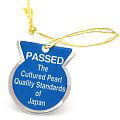
What it means:
- The pearl is structurally sound
- The nacre is sufficient
- It is suitable for sale
What it does not mean:
- That it is high quality
- That it is better than pearls without a label
- That it was grown in Japan
Think of it as a basic inspection — not a mark of excellence.
3. “Retail Price” and Other Illusions
“Retail price $1350 — our price $270 — you save 80%.”
This is not pricing — it’s positioning, and the two are very different things.
“Retail” is rarely defined, and often meaningless outside of very specific luxury retail environments.
These claims are worth ignoring entirely.
If you want to understand how pearl pricing actually works, this is a more useful place to start:
why pearl jewelry is often overpriced.
4. Stock Photos vs Reality
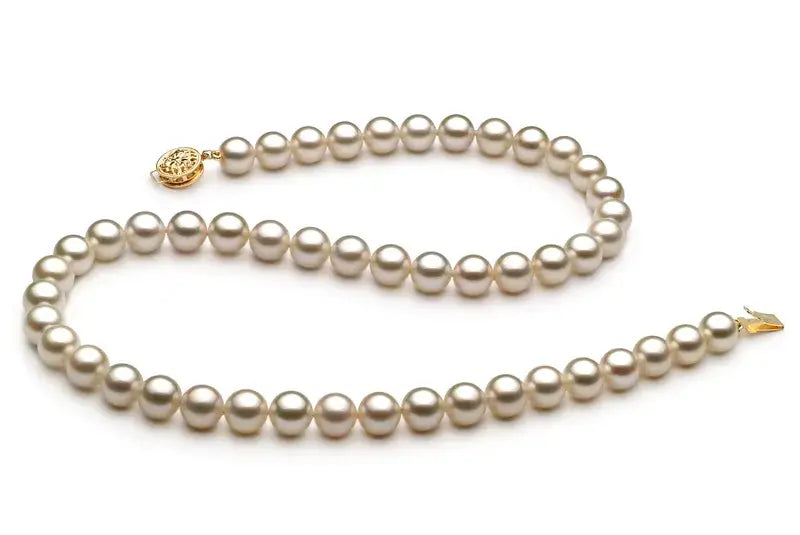
Pearls are not identical, not flawless, and they do not look like perfectly manufactured spheres.
If every pearl in a photo looks exactly the same, you are not looking at the actual piece.
Always ask for real images — ideally video.
And expect variation. That is part of what makes pearls real.
If you’re not sure whether what you’re looking at is genuine, here’s how to tell if pearls are real — without guessing.
So How Do You Protect Yourself?
Know Your Seller
This matters more than any label, tag, or grading system.
A knowledgeable pearl specialist will:
- Explain quality without hiding behind terminology
- Show real pieces — not representations
- Be consistent in how pearls are selected and described
If you want to understand what separates a trustworthy seller from one who isn’t, this goes into exactly that.
If you want a clearer framework for choosing pearls step by step, this guide connects everything:
how to choose a pearl you won’t regret buying.
The goal is not to avoid every mistake.
It is to understand enough that the right choice becomes obvious — and the wrong ones stop looking tempting.