


To understand pearl pricing, you first need to understand what it actually takes to get a pearl to market.
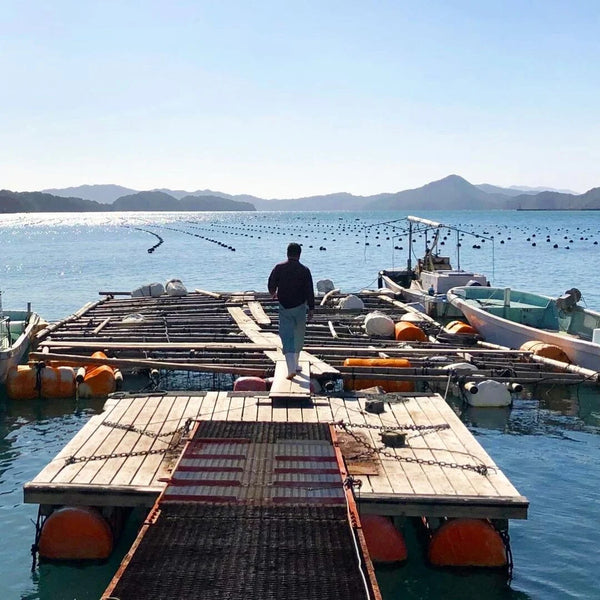
Pearl cultivation begins with raising mollusks to maturity — a process that usually takes two years, filled with constant challenges: protection, nutrition, environmental control, and more, long before any pearls are formed. The cost of time, money, and labor in this phase alone cannot be overstated.
Despite advancements in technology, less than half of all oysters survive nucleus implantation. If the technicians are exceptionally skilled — hailing from Japan with vast experience — up to 50–70% of pearl oysters may survive the operation. Of these survivors, only 20% will go on to produce marketable pearls.
So what are you actually paying for when you buy a fine pearl? Saltwater pearls are expensive because most oysters do not produce a high-quality pearl. Years of labor, high mortality rates, and extremely low success rates are built into every pearl’s price.
To understand what makes one pearl more valuable than another in the first place, here’s how the key value factors work.
Why do so many oysters die?
Besides attrition during nucleus implantation, not all oysters recover fully from the operation. Some succumb to disease. When saline bays are flooded with rainwater, diluting salinity, oysters may perish if levels drop too low — or rise too high. Constant monitoring is required to adjust cage depths according to conditions.
The dreaded “red tide” — an algae bloom that suffocates marine life — can devastate entire farms. Japan has developed countermeasures, including sensors attached to nets that detect phytoplankton levels and allow timely relocation. But these countermeasures add cost.
Some oysters starve due to lack of nutrients. Others are preyed upon or infested with parasites, requiring treatment: rubbing each one with salt, alternating freshwater and saltwater baths to kill surface parasites — across thousands of oysters. Daily care over one to three years, monitoring diet, safety, health, and cleanliness. Every hour of that care translates into cost.
Quality pearls cannot be cheap. Cheap pearls exist — but they are either lower-grade saltwater pearls or mass-produced freshwater pearls with different value dynamics entirely.
How many oysters produce high-quality pearls?
Only 5% of all surviving oysters will grow perfectly round, lustrous pearls with good color. Another 15% yield pearls of irregular shape and/or good but not exceptional luster. The rest are of low commercial quality, unsatisfactory, or simply waste — and yet the same amount of time, money, labor, and care has been invested in them as in the others. The viable pearls must compensate for all the rest.
This is what you are paying for when you buy a fine pearl: not just the object, but the years of care, the risk, and the overwhelming probability of failure that preceded it.
What happens after pearls are harvested?
This is where the real selection begins. Sorting reveals whether the technicians’ work was justified. A cut in a gonad even slightly larger than necessary, at the wrong place or the wrong time in the oyster’s life cycle, can lead to death, nucleus rejection, uneven nacre, absence of nacre altogether, or a compromised color. There are numerous ways things can go wrong. There is only one way everything goes right.
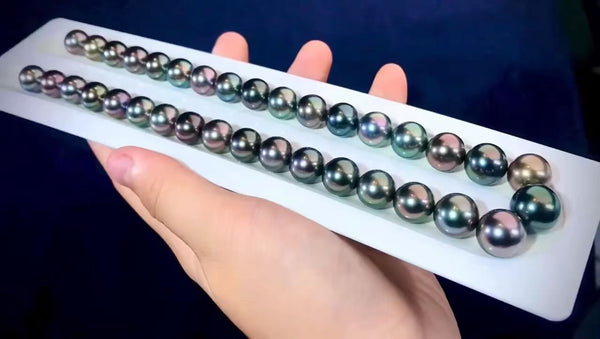
Sorting is the most important post-harvest process. Farmers must sort thousands of pearls by size, shape, color, and luster — a process every commercially viable pearl goes through multiple times, from the moment the shell is opened to the final price tag.
After sorting, pearls must be drilled with precision. A single pearl drilled slightly off-center disrupts the symmetry of the entire piece.
To find 30–50 pearls for a perfectly matched 16-inch necklace, a sorter must select from over 10,000 pearls. This is why pearls, despite being cultivated at scale, remain rare and valuable. It is not just the object — it is the work, the precision, and the dedication behind it.
Frequently Asked Questions
Why are saltwater pearls expensive?
Because very few oysters produce high-quality pearls, and the process takes years with high loss rates at every stage. The price of a fine pearl reflects not just the pearl itself, but every oyster that didn’t make it.
How many pearls are actually used in fine jewelry?
Only a small percentage — often less than 5% of harvested pearls meet fine jewelry standards. The rest are sold at lower grades or discarded.
Are all saltwater pearls valuable?
No. Many are low-grade and do not meet fine jewelry standards. Origin alone — Akoya, South Sea, Tahitian — does not guarantee quality. The individual pearl does.
What are you really paying for?
Time, risk, labor, and the rarity of high-quality outcomes. And the sorting — the extraordinary amount of human judgment required to find the few pearls worth keeping.
If you want to understand how this plays out in retail pricing, here’s why most pearl jewelry is overpriced — and how to tell. And if you’re wondering what the price difference between pearl types actually reflects, here’s why pearls are so expensive — and when they shouldn’t be.