


Not all black pearls are the same. The term covers three very different products — dyed Akoya, treated freshwater, and natural Tahitian — with different origins, treatments, quality levels, and price ranges. Here is what you need to know about each. Prices below refer to a strand of pearls.
Black Akoya Pearls
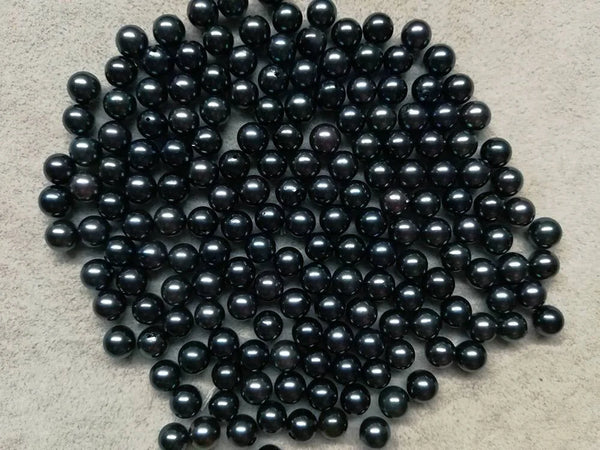
Naturally black Akoya pearls do not exist. They are dyed — typically to a color spectrum ranging from black-blue to black-green, usually very dark. The dye penetrates deep into the porous nacre, staining even the core of the pearl.
This process often removes the pearl’s natural iridescence, leaving the surface a uniform color with a flat, sometimes plastic-like shine. These pearls generally range from 5.0 mm to 10.0 mm in size. Market price varies from a few hundred to a few thousand dollars, depending on size, luster, and surface quality.
Black Freshwater Pearls
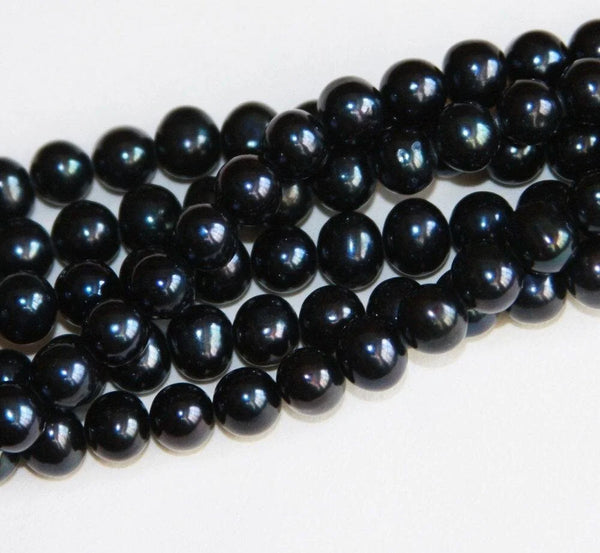
Black freshwater pearls are either dyed or irradiated. Irradiation produces a more vibrant and diverse color range — multicolored peacock, denim blue, purple-pink, rich blue-green — with a distinctive iridescence. Small black spots are often visible on the surface where the treatment didn’t fully penetrate.
Dyed black freshwater pearls closely resemble dyed black Akoya in color, size, and luster. The easiest way to tell them apart is shape: Akoya pearls are perfectly round; freshwater pearls range from round to oval. When the price seems unusually low for what’s being described as Akoya, that’s worth paying attention to.
Market price ranges from a few dollars to several hundred dollars for perfectly round, clean specimens.
Black Tahitian Pearls
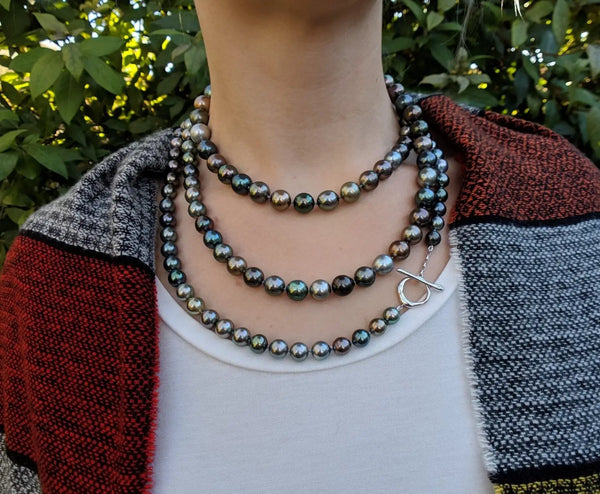
Tahitian pearls are the only naturally dark pearls farmed and readily available in the jewelry market. No dye, no irradiation — the color is entirely the product of the black-lipped oyster Pinctada margaritifera and the conditions in which it grows.
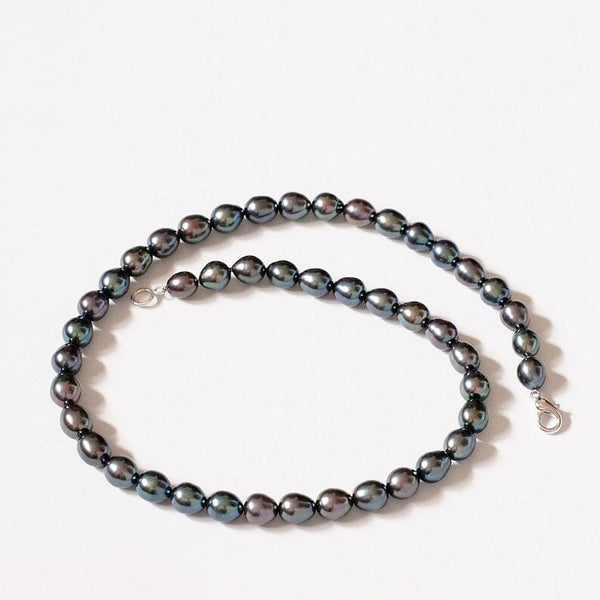
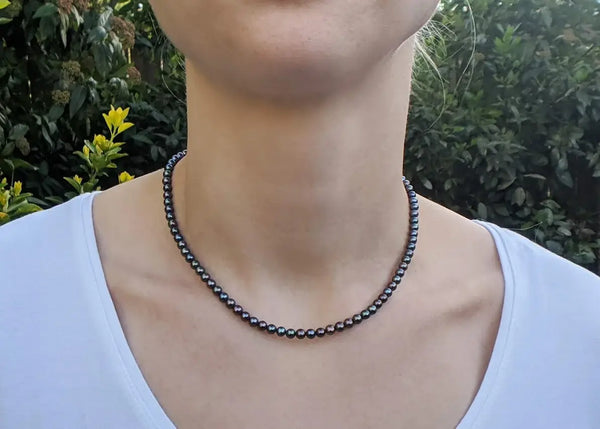
Size typically ranges from 8 to 15–16 mm. Surface color varies from light silvery white and light blue to dark gray and intensely black, with dark gray hues and silver or steel overtones being most common. Other prevalent overtones include peacock, green, aquamarine, rose, and eggplant.
The absence of treatment results in a surface that radiates a subtle, intense iridescence — a depth of color that dyed pearls cannot replicate. This applies, of course, to high-quality Tahitian pearls. Quality varies considerably.
Market price spans from $2,000 to $5,000 for baroque pearls, rising to $15,000 and beyond for round pearls with clean surfaces and excellent luster.
I carry a very limited number of dyed pearls — you are welcome to explore the natural black pearl collection here. For a broader look at how dyeing works and what you should always be told, read this article on dyed pearls and disclosure.