



Men have worn pearls for centuries — on crowns, on swords, on the necks of kings and merchants. The recent cultural moment around men’s pearl jewelry has brought that back into view. What follows is a practical look at what’s available, and what tends to suit different intentions.
Whether it’s a single black pearl on a silver chain, a Tahitian pearl on a leather cord, a pair or a single pearl stud, or a strand worn close to the collar — the right piece completes the look and brings genuine pleasure to wear.

The Solitaire on a Cord or Chain
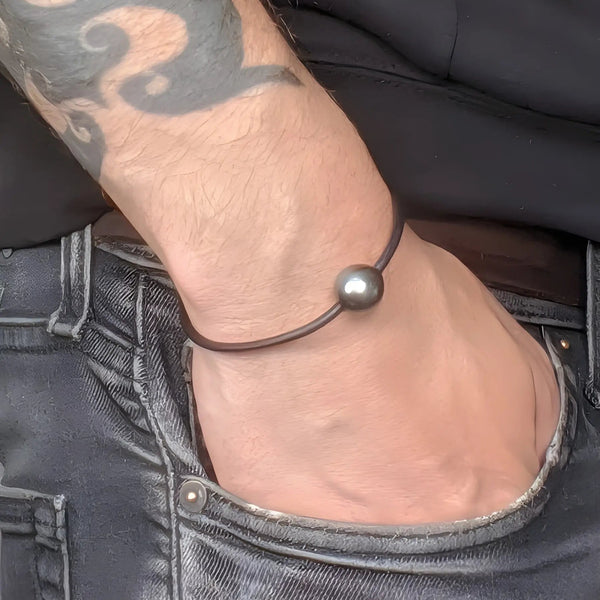
The single pearl on a leather cord or a silver chain is the quietest option — and often the most versatile. The leather grounds the pearl, removing any softness it might carry on its own. The adjustable length lets it sit where it should, whether over a t-shirt or just under a collar.
A Tahitian pearl on a leather cord is the most direct version of this — the dark body color, surface texture, and weight all suit it. The bracelet version follows the same logic: one pearl, one cord, nothing else.
The solitaire on a silver chain sits slightly differently — more refined, working easily under a shirt or just visible at the collar. The Edison freshwater solitaire is a larger, rounder pearl with more presence — still a single pearl.
The Strand
The strand worn by men — loose, close to the collar, or slightly longer — is a real and established look, not a passing moment. The question is mostly one of scale and color.
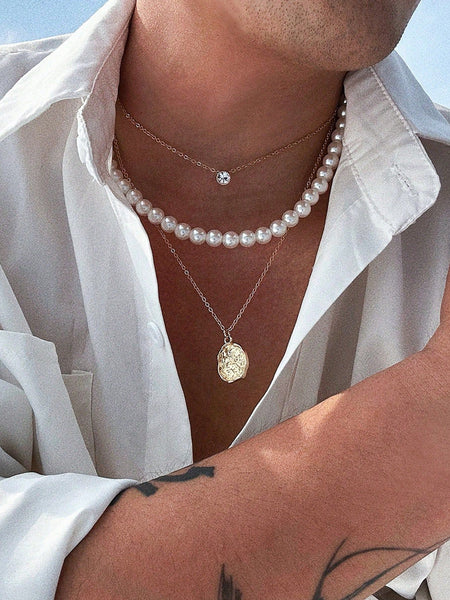
A thin seed freshwater strand at 3.5–4mm sits close to the skin and reads as minimal — almost like a fine chain, but with more surface interest. It layers well or works alone.
A blue Akoya strand moves in a different direction — larger pearls, a distinctive silvery-blue body color, more visual weight. Worn alone, it’s enough.
A Tahitian pearl strand takes it further — 8–10mm drop-shaped pearls in the dark, complex tones Tahitians are known for. More presence than either of the above, and a piece that needs nothing around it.
For more on what makes Tahitian pearls distinctive, here’s the full Tahitian pearl guide.
Before You Buy
Size is worth considering. Smaller pearls — under 6mm — tend to read as delicate in isolation; in a strand they work differently, as the cumulative effect carries the weight. Larger solitaires (9mm and up) have enough presence on their own.
Color matters more here than it’s often given credit for. Bright white, perfectly round, high-luster pearls can pull toward formal or bridal. Darker tones, blue or grey overtones, slight surface character — these tend to sit more comfortably in a casual or everyday context.
If you want to understand how color and overtone work across pearl types, here’s what makes blue Akoya so distinctive.
Wear it:
- White Akoya or freshwater strand with a plain white t-shirt
- Leather cord solitaire with a dark crewneck or open collar, worn daily
- Blue Akoya strand with a simple button-down, no tie — the color carries it