


Pearl Cultivation: Where It All Started
At the end of the 19th century, Henry Lister Jameson — a British zoologist who studied pearl formation — noted:
“The man who solves the riddle of pearl cultivation will not only have the privilege of contributing to scientific and industrial progress, but his name will deserve the honor of entering the history of empire builders.”
The history of pearl cultivation — human intervention in pearl birth — dates back to the 13th century. It originated in China, where pearls were cultivated in the likeness of Buddha. The Chinese discovered that if a small dome-like shape was attached to the shell of a freshwater mussel under its mantle, the mussel would eventually cover it with nacre, creating a blister pearl that mirrors the shape of the implant.
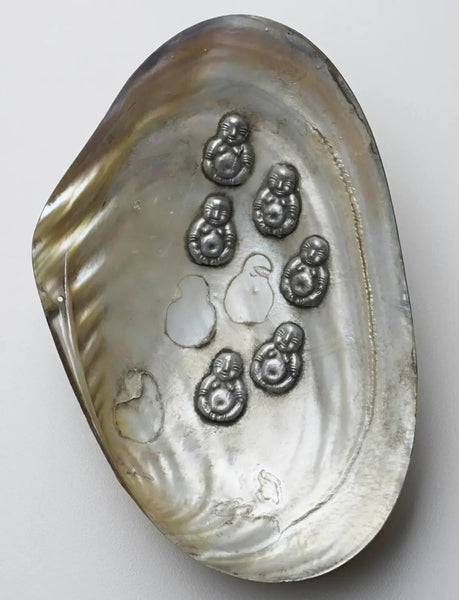
When the blister pearl is cut from the shell and the implant removed, the void inside is filled with a hardening substance and closed with a piece of nacre cut from the shell. This type of composite pearl is called a mabé. The method is still used to cultivate both saltwater and freshwater hemispherical pearls today.

Mabé pearls of today
Despite numerous attempts to cultivate spherical pearls over centuries, results were mostly unsuccessful. In 1761, Swedish naturalist Carl Linnaeus experimented with pearl cultivation techniques, but achieved only semi-spherical pearls attached to the shell — not free-floating spheres inside the oyster.
The first person to achieve a free-floating cultured pearl was British marine biologist William Saville-Kent, working in northwestern Australia. Systematic research then continued in Japan, focused on the native Akoya oyster — and today Japan is credited as the homeland of the cultured pearl.
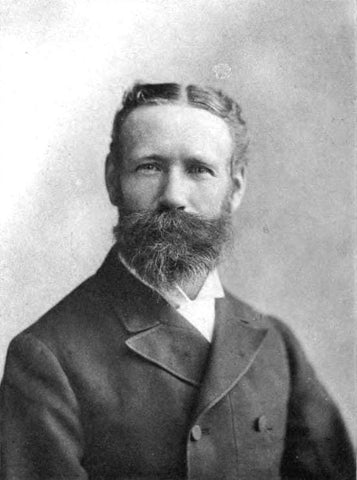
Sir William Saville-Kent
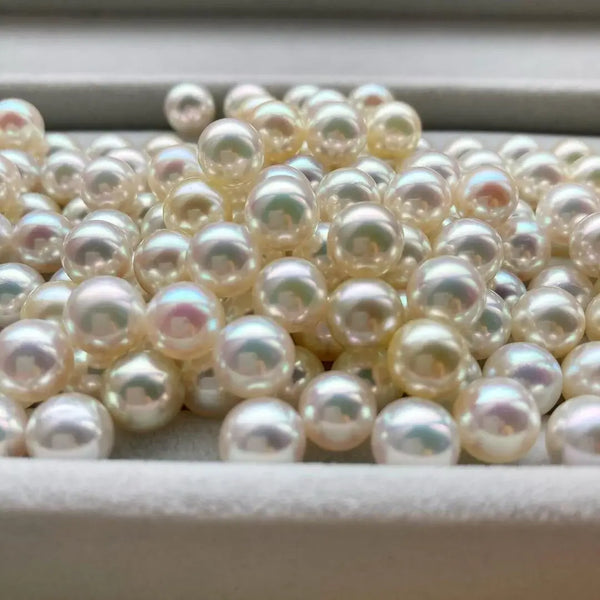
When most people picture a pearl, they picture an Akoya: white, round, shiny, worn in a strand. It is the classic cultured pearl, farmed for over a hundred years. The finest specimens have a glow rarely seen in other pearl types — which is why Akoya remains the benchmark for pearl jewelry.
Those familiar with Akoya have heard of Kokichi Mikimoto. His story is so intertwined with the pearl industry that “Mikimoto” has become practically synonymous with cultured pearls. His tenacity, business acumen, and long life made him a legendary figure — and his brand remains the most recognized pearl brand in the world.
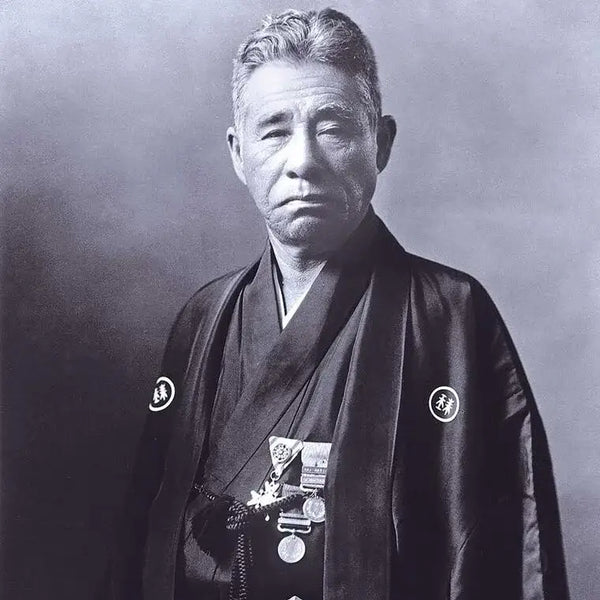
Mikimoto launched his first experimental pearl farm in 1890 on the small island of Benten-shima, inspired by the ancient Chinese method of cultivating blister pearls. His goal was to reproduce the technique using Japanese Akoya oysters (Pinctada fucata martensii).
His first harvest in 1891 yielded nothing. He grafted a variety of nuclei — abalone shell, coral, bone — into 5,000 oysters. Another failure. He then hypothesized that mother-of-pearl beads, made from the same substance as pearls, might be the key. In 1893, he cultivated his first blister pearls using that approach. His hunch was right.
By 1916, at the age of 58, Mikimoto began mass production of Akoya cultured pearls. That year marks the official birth of the cultured pearl industry.