


Are you wondering if your pearls are real or fake?
With increasingly realistic imitation pearls on the market, it's harder than ever to tell the difference. From Majorica pearls sold in department stores to convincing shell pearls and Swarovski crystal pearls, imitations have become sophisticated enough to mislead even experienced buyers.
The good news is that real pearls have characteristics that imitations cannot fully replicate. With a decade of experience sourcing and evaluating pearls, I'll show you how to identify authentic pearls using simple at-home tests and careful visual inspection.
In this guide, you'll learn:
- how to visually identify real vs fake pearls
- the friction test (a better alternative to the tooth test)
- common types of imitation pearls and how to recognize them
- price indicators that reveal fakes
- when to seek professional authentication
Whether you're buying pearls, inherited a strand, or evaluating a piece of jewelry, this guide will help you assess them with confidence.
Quick Answer: How to Tell if Pearls Are Real
- Visual inspection: Real pearls show slight imperfections, subtle color variation, and depth in luster. Fake pearls appear overly uniform, smooth, and surface-shiny.
- Friction test: Gently rub two pearls together. Real pearls feel slightly gritty due to microscopic nacre layers. Fake pearls feel smooth and slide easily.
- Weight: Real pearls feel more substantial than plastic or hollow imitations.
- Temperature: Real pearls feel cool at first and warm gradually. Plastic pearls feel close to room temperature immediately.
- Price: High-quality pearls are never inexpensive. Fine pearl strands range from hundreds to thousands of dollars, not $20–50.
Bottom line: If pearls are perfectly round, flawless, uniformly colored, smooth to the touch, and inexpensive, they are almost certainly imitation.
No single test is definitive — use several together for accuracy.
Visual Inspection — Your First and Best Tool
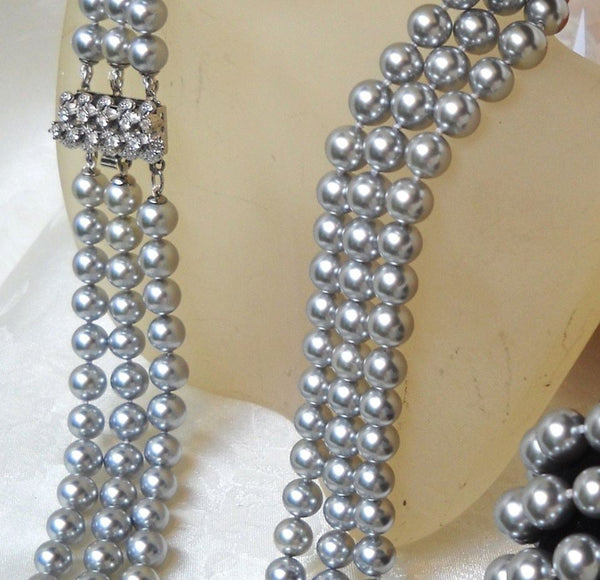
Your eyes are the most reliable tool for identifying real pearls. Careful observation will reveal differences that imitations cannot fully replicate.
Step 1: Set Up Your Inspection
- Place the jewelry on a plain white sheet of paper
- Use bright, natural light (near a window is ideal)
- Examine each pearl individually, inch by inch
- Use a magnifying glass if available
Step 2: Ask These Critical Questions
1. Are ALL the pearls perfectly round?
Real pearls: Show natural variations in shape — slightly oval, off-round, or baroque.
Fake pearls: Perfectly spherical with machine-like precision.
2. Do you see surface imperfections?
Look for wrinkles or ripples, tiny dents or bumps, chalky spots, pinpricks, or small blemishes.
Real pearls: Will have at least some minor surface imperfections — the mollusk's "fingerprint."
Fake pearls: Often have flawless, glass-smooth surfaces.
3. Can you see depth beneath the surface?
Hold pearls up to a strong light source and look closely.
Real pearls: You'll see lighter or darker areas beneath the surface — organic accumulations of conchiolin, a protein that's part of nacre.
Fake pearls: Uniform throughout with no subsurface variations.
4. Do the colors vary slightly from pearl to pearl?
Real pearls: Subtle color variations and overtone differences, even in "matched" strands.
Fake pearls: Identical color across all pearls — too uniform.
5. What kind of luster do you see?
Real pearl luster: Soft, glowing radiance with depth and complexity — light seems to come from within.
Fake pearl luster: Plastic-like, surface-only shine — flat, one-dimensional, no depth.
6. Do you see orient (iridescence)?
Orient is a rainbow effect that shimmers faintly on the pearl surface.
Real pearls: May have subtle, soft orient.
Fake pearls: Either no orient, or excessively intense, artificial-looking iridescence.
The "Too Perfect" Red Flag
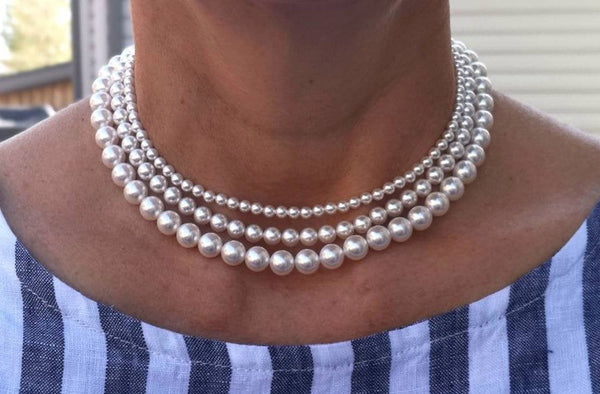
Cultured pearls are formed by a living organism. Even with human intervention, the mollusk builds the pearl over months or years, leaving natural variation in the result. If pearls appear perfectly round, flawless, identical in color, and uniformly glossy, they are unlikely to be genuine.
Natural formation introduces variation. Perfect uniformity is a sign of manufacturing. Nature does not produce identical results. Machines do.
The Friction Test (A Better Alternative to the Tooth Test)
You may have heard of the "tooth test" — rubbing a pearl against your front teeth to detect a gritty texture. While it can work, it's not a method I recommend. From a practical standpoint, it's not hygienic. You don't know where the pearls have been or how they were handled.
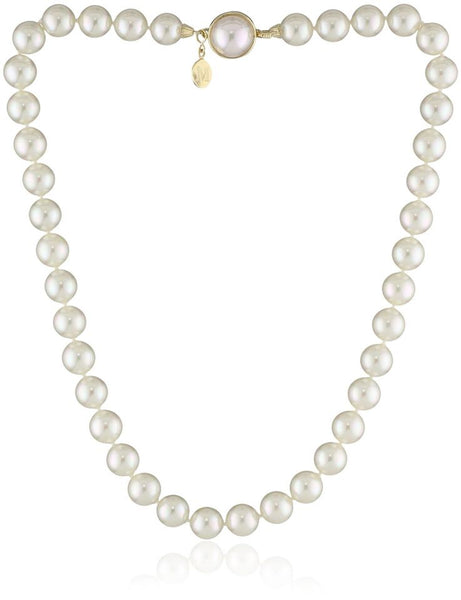
Instead, gently rub two pearls together. Real pearls feel slightly gritty due to microscopic nacre layers. Fake pearls feel smooth and slide easily.
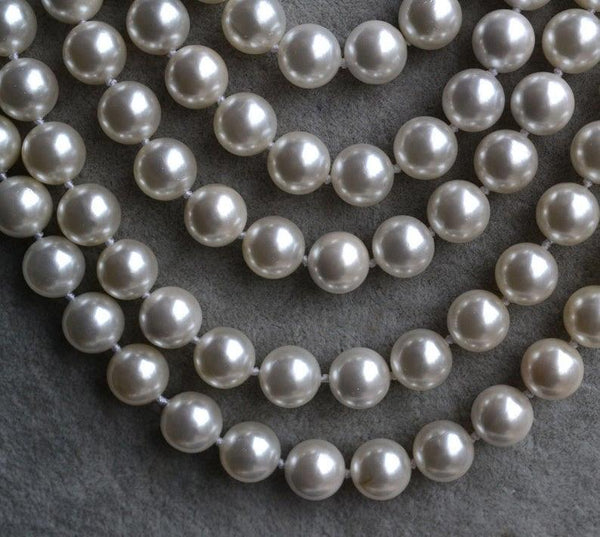
To understand why real pearls feel gritty, here's how nacre actually forms layer by layer.
Important Caveats
The friction test is reliable, but not definitive. Use it together with visual inspection and other indicators.
Exception: If real pearls have been coated with lacquer (which indicates lower quality), they may feel smooth.
Shell pearls: Pearls carved from oyster shells may feel slightly textured because they are made from real shell material. In these cases, rely more on visual inspection — particularly uniform color, overly consistent luster, and perfect shape.
Other At-Home Tests
Weight Test
Real pearls feel substantial and heavier for their size. Fake pearls are lightweight (plastic) or hollow. Hold a pearl in your palm — real pearls have a noticeable density relative to their size.
Temperature Test
Real pearls feel cool to the touch initially and warm gradually with body temperature. Fake pearls feel close to room temperature immediately (plastic) or remain cool without warming (glass). Place the pearl against your cheek or neck to test.
Drill Hole Inspection
If the pearls are strung, examine the drill holes with a magnifying glass. Real pearls have clean, well-defined holes with visible layers of nacre inside. Fake pearls show peeling or flaking coating around drill holes, uniform interior with no visible layering, or rough hole edges.
Common Types of Fake Pearls
Now that you know how to test pearls, it helps to understand the most common types of imitation pearls you're likely to encounter.
1. Majorica Pearls
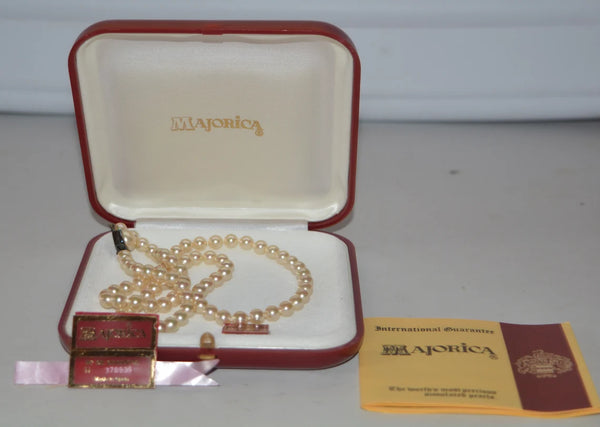
What they are: High-quality imitation pearls manufactured since the late 1800s on the Spanish island of Mallorca. Often sold in department stores and presented as premium alternatives to natural pearls.
How they're made: Solid glass core coated repeatedly with "essence d'orient" (ground fish scales, powdered shell, and oils) — often around 30 coatings, hand-polished between layers.
Typical colors: White, black, gray, gold — chosen to closely resemble natural pearl colors. Now also produced in baroque shapes, making them more convincing.
How to identify: Feel smooth during the friction test, show surface-only shine rather than depth, appear overly uniform in color and shape, typically priced $50–300 per strand. Comparable real pearls of similar size would range from $1,000 to $10,000 or more.
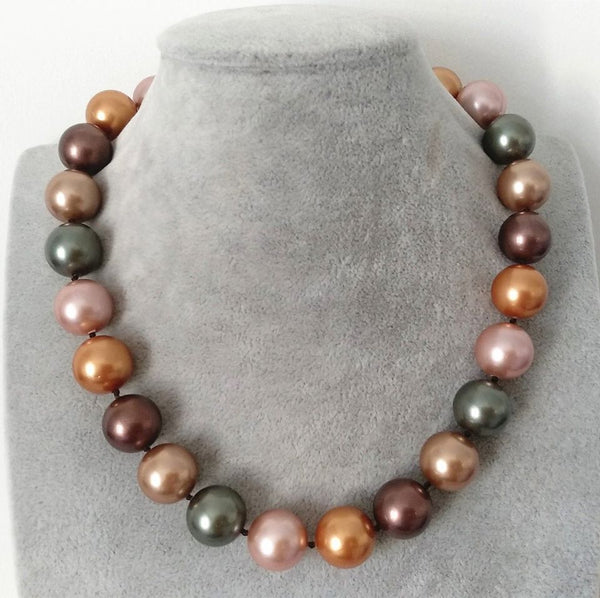
2. Shell Pearls
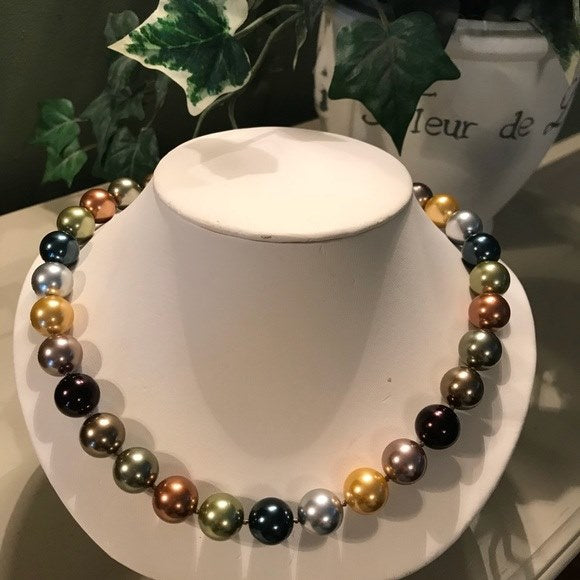
What they are: Made from real oyster shells, which makes them more convincing than most other imitations. Either ground into powder and applied as a coating, or carved directly from thick areas of oyster shell, then dyed and polished. Often designed to imitate South Sea pearls — white, black, gray, gold, pistachio, chocolate, and soft pink tones. Typically 10–14mm.
How to identify: Friction test may feel slightly textured (misleading), luster is overly even and surface-level, color is solid and uniform without natural variation, shape is consistently perfect, typically priced $30–200 per strand.
3. Swarovski Crystal Pearls
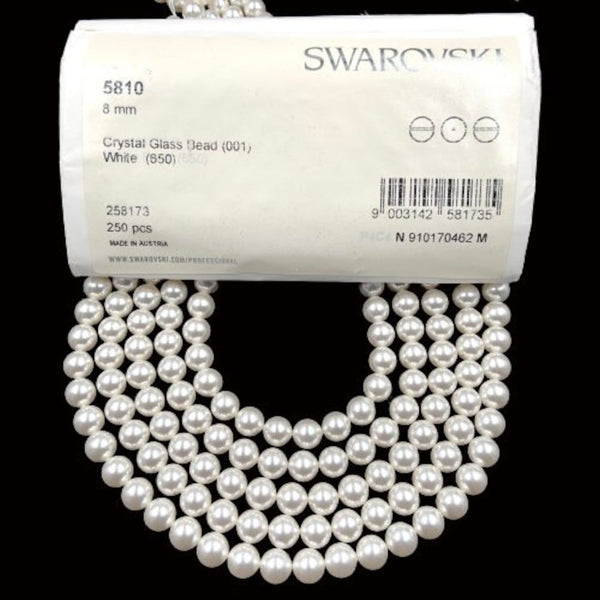
What they are: Made with a Swarovski crystal core coated with a pearl-like substance. Clearly identified by the manufacturer as artificial. Very strong, surface-level shine with perfect consistency in size and color. Highly durable compared to real pearls.
How to identify: Extremely bright, reflective surface — often appears too uniform. May include Swarovski branding. Typically priced $20–150 per strand.
4. Kenneth Jay Lane Pearls
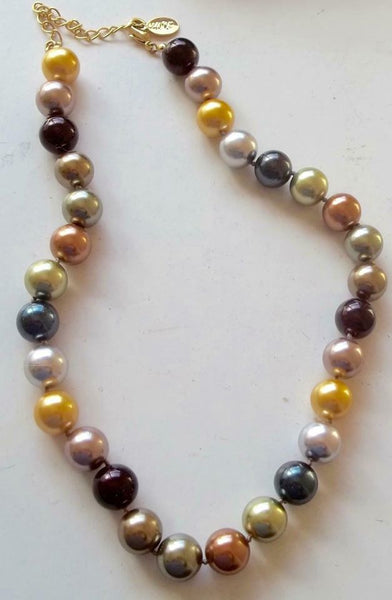
What they are: Glass bead imitation pearls produced in the Czech Republic, sold by the designer brand for over 50 years. Worn by figures such as Jackie Kennedy and Barbara Bush. Clearly identified as imitation, often marked with KJL fittings.
How to identify: Marked with KJL fittings, perfectly shaped with smooth flawless surfaces, glass-like surface-level shine, typically priced $50–300. I keep a strand in my own collection as a reference example of high-quality imitation pearls — well-made and visually convincing, but not intended to replicate the structure or value of real pearls.
5. Cheap Plastic Pearls
What they are: Low-quality plastic beads with pearlescent coating. Extremely lightweight, feel warm or neutral to the touch, obvious plastic-like shine. Often found in low-cost costume jewelry, typically priced $5–30. The easiest imitations to identify — usually do not require detailed testing.
Price as an Indicator
Price is one of the simplest and most reliable indicators. Real pearls with strong luster, clean surfaces, and larger sizes cannot be inexpensive.
Fake pearls: Plastic $5–30 • Shell $30–200 • Majorica $50–300 • Swarovski $20–150
Real pearl strands (approximate ranges):
- Freshwater Pearls: 6–7mm $200–500 • 8–9mm $500–1,200 • 10–11mm $1,200–3,000+
- Akoya Pearls: 7–7.5mm $1,500–3,000 • 8–8.5mm $3,000–6,000 • 9–9.5mm $4,500–10,000+
- Tahitian Pearls: 9–10mm $2,000–4,500 • 11–12mm $5,000–10,000 • 13–14mm $10,000–20,000+
- South Sea Pearls: 10–11mm $3,000–6,000 • 12–13mm $6,000–12,000 • 14–15mm $12,000–30,000+
Real pearls typically cost 10 to 100 times more than convincing imitations of similar size. If you see "South Sea pearls" priced at $200, they are not genuine.
For more on what drives pearl pricing, here's how pearl value is actually determined.
Seller matters too. Reputable sources: established pearl specialists, fine jewelry stores, certified gemologists, auction houses. Red flags: street vendors, flea markets, "too good to be true" online deals, sellers who can't provide authentication or origin information.
When to Seek Professional Authentication
While the tests in this guide are highly reliable for most situations, seek professional authentication if you're spending $1,000+, evaluating inherited or vintage jewelry, need insurance documentation, or get conflicting test results. Also for rare or unusual pearls — natural pearls, Melo pearls, conch pearls.
Professionals can perform X-ray examination, microscopic analysis, and spectroscopy — things you can't do at home. Cost: $50–200 for basic authentication, $200–500+ for a full gemological report.
Frequently Asked Questions
How can I tell if my pearls are real at home?
Use a combination of visual inspection and the friction test. Real pearls have slight imperfections, color variations, complex luster, and feel gritty when rubbed together. Also check weight and temperature.
What is the tooth test for pearls?
Rubbing a pearl against your front teeth — real pearls feel slightly gritty, fake pearls feel smooth. I don't recommend it due to hygiene concerns. The pearl-to-pearl friction test is safer and equally effective.
Are all cheap pearls fake?
Not necessarily, but price is a strong indicator. Small freshwater pearls can be relatively affordable ($100–300), but large, high-quality pearls are always expensive. If you see "South Sea" or "Tahitian" pearls for under $500, they're almost certainly fake.
Can fake pearls pass the friction test?
Most fake pearls will feel smooth. However, shell pearls may feel slightly textured. That's why you should combine the friction test with visual inspection.
How can you tell if vintage pearls are real?
Use the same tests. For valuable vintage or antique pieces, I recommend professional authentication by a certified gemologist, as some vintage imitations are very sophisticated.
What's the difference between natural and cultured pearls?
Natural pearls form entirely by chance in the wild (extremely rare and expensive). Cultured pearls are created with human intervention — a nucleus is inserted into the mollusk, which then coats it with nacre. Both are real pearls. Today, 99%+ of pearls on the market are cultured.
Are Majorica pearls worth anything?
Majorica pearls are high-quality imitation pearls worth $150–1,000+ depending on size and style. They have value as costume jewelry but are not investment pieces like real pearls.
How do I know if my pearls are Akoya, Tahitian, or South Sea?
Akoya: smaller (6–9mm), white/cream with rose or silver overtones, from Japan/Vietnam/Australia. Tahitian: dark colors (black, gray, peacock, green), 8–14mm, from French Polynesia. South Sea: large (10–20mm), white or golden, from Australia/Philippines/Indonesia. Professional authentication may be needed for definitive identification.
Can I wear imitation pearls every day?
Yes, imitation pearls (especially Swarovski or Majorica) are often more durable than real pearls and can withstand daily wear better. However, they won't appreciate in value like genuine pearls and lack the natural beauty and luster of the real thing.
Do real pearls have to be perfectly round?
No. Perfectly round pearls are rare and command premium prices. Perfect roundness across an entire strand is a red flag for fake pearls.
You Now Have the Tools to Identify Real Pearls
With the knowledge from this guide, you can assess pearls using visual inspection, the friction test, weight and temperature differences, price as a reality check, and an understanding of common imitation types.
The key principle: If pearls appear perfectly uniform, feel completely smooth, and are priced unusually low, they are unlikely to be genuine.
Real pearls are products of nature — beautifully imperfect, with subtle variations that make each one unique. That's what makes them precious.
If you're unsure about a piece, reach out for guidance.