



For generations, pearls have been explained with a simple story: something irritates an oyster, and the animal coats it until a pearl forms. It’s memorable, and it’s wrong — because if irritation alone were the cause, the process would stop once the problem is resolved.
The Real Beginning
A pearl begins when nacre-producing epithelial cells from the mantle are displaced from their original position.
Inside every mollusk is a specialized layer of tissue called the mantle. This tissue is responsible for building the shell, using a highly controlled process known as biomineralization.
In nacre-producing species, these cells regulate:
- the type of crystal formed
- the orientation of those crystals
- and the way layers are assembled over time
Under certain conditions — injury, parasite activity, shell damage, or human intervention — some of these cells can become dislodged and embedded within the mollusk’s soft tissue.
That is the critical event. Not irritation — but the relocation of functional, nacre-producing cells.
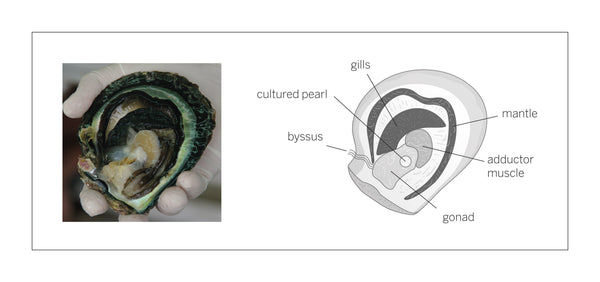
Photograph and illustration of the Tahitian pearl oyster (Laurent Cartier, SSEF). The gonad — the reproductive organ of the mollusk — is the area where mantle tissue and a nucleus are implanted for the production of cultured pearls.
When Cells Continue Their Function
If these displaced cells remain viable, their function does not change. They continue doing exactly what they were designed to do. They multiply, organize, and form a small enclosed structure known as a pearl sac.
This sac is not passive. It functions as mantle tissue, now operating internally. And its function is unchanged: to grow shell material.
Nacre Forming Internally
The pearl sac begins secreting successive layers of nacre — the same structure that lines the inner shell:
- first an organic matrix
- followed by layers of mineral
In pearl oysters, this results in nacre — a highly ordered structure composed of microscopic layers of aragonite. The precision of these layers determines luster, surface quality, and depth (orient).
Because of this structure, light does not simply reflect from the surface — it interacts with the layers themselves, creating the visual qualities associated with fine pearls.
It is nacre being produced internally by cells that have been displaced, but not altered in function.
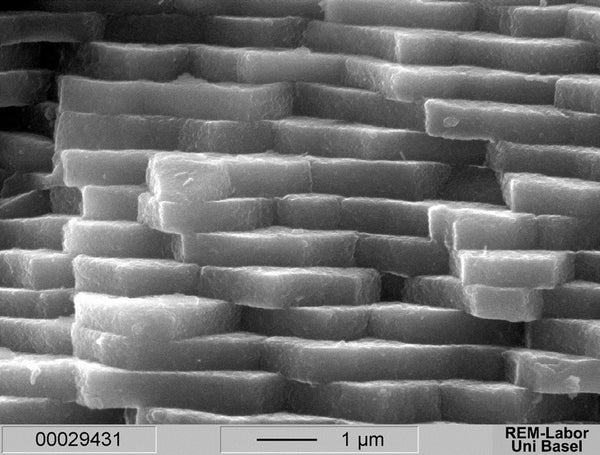
Microscopically thin layers of aragonite crystals, laid in plate-like arrangements, make up the foundational structure of pearls and oyster shells. Diffraction within these layers results in the iridescent effect known as “pearl orient” or Aurora effect. Photo: H. A. Hänni & Uni Basel.
Where Irritation Fits
Irritation may be present — but it is not the mechanism. It is, at most, a trigger — not the cause. It can damage mantle tissue, introduce foreign material, and create the conditions that allow epithelial cells to be displaced. But without those displaced cells forming a pearl sac, no true pearl develops.
In many cases, the mollusk simply isolates the disturbance with irregular mineral deposits — without producing a structured pearl.
Natural and Cultured Pearls
The biological process is the same in both. The difference lies only in how it begins.
Natural pearls occur when this cellular displacement happens by chance, which is why they are rare.
Cultured pearls begin with deliberate intervention: a nucleus is inserted along with a small piece of donor mantle tissue. That tissue provides the necessary nacre-producing cells. Without it, there is no pearl sac — and no pearl.
Culturing does not create nacre. It simply initiates the process intentionally.
The videos below show this process more clearly than text or images. Both are courtesy of SSEF (Swiss Gemological Institute).
Natural Pearl Formation
Cultured Pearl Formation
Why Species Matters
Even when this process occurs, the result depends entirely on the species. Pearl oysters produce structured nacre. Other mollusks, including edible oysters, produce different, less ordered materials. So the outcome is not defined by the event — but by what those cells are biologically equipped to produce.
If you’d like to explore why edible oysters and pearl oysters produce such different results, here’s the comparison between edible and pearl oysters.
The Core Idea
A pearl is nacre-producing epithelial cells, displaced from the mantle, continuing their function — growing nacre layer by layer — inside a living organism. When those layers are precise enough, the result is structure and light from within.
Understanding this replaces a simplified story with a more accurate one — grounded in cellular function, precision, and persistence.
For more on how the culturing process affects color and quality, here’s how blue Akoya pearls form as a direct result of the grafting process.
For more information see the FAQ on Pearl Formation.