


I have a growing collection of pearl books that I genuinely love — especially the older ones, and especially the autobiographies of historical pearl merchants. They fill in corners of the story that no academic source bothers with. Today I’m continuing the history of the cultured pearl industry, picking up where Part I left off — and getting into the part where it gets interesting. Patents, rivalries, and a very convenient marriage.
First Patents
Kokichi Mikimoto, a shrewd and forward-thinking businessman, secured a patent in 1896 for an ancient Chinese pearl cultivation method.
His initial productions were hemispherical pearls — known today as Akoya mabé pearls. He crafted these by slicing and fusing two halves of a shell, a technique that paved the way for the commercial cultivation of blister pearls.
By 1902, Mikimoto had achieved mass production of blister pearls, with a million mollusks charged with hemispherical nuclei. Mikimoto Pearls gained popularity across Japan, China, Europe, and the USA.
Determined to go further, Mikimoto pursued the cultivation of spherical pearls — his goal was to replicate the esteemed “oriental pearls,” the name given for centuries to the natural pearls of the Persian Gulf. In 1905, he wrapped the nucleus in living mantle tissue from another mollusk, using epithelial cells crucial for natural pearl formation. He used natural pearls and mother-of-pearl beads as nuclei, which produced pearls that didn’t crack or explode when drilled — unlike those with metal cores. It is also noted that inside the first Mikimoto pearls, beeswax was found as the core (Leonard Rosenthal, ‘The Pearl King’).
In 1908, Mikimoto patented this method, believing he had discovered the world’s first technique for cultivating spherical pearls.
Tokichi Nishikawa and Tatsuhei Mise
In 1901, marine biologist Tokichi Nishikawa was sent to work at the Arafura Pearling Fleet in the Australian Torres Strait — a company employing about 2,000 divers collecting shells for mother-of-pearl. There Nishikawa first encountered pearls, and most likely participated in some way in the successful experiments in growing spherical pearls conducted by Sir William Saville-Kent. The English aristocrat, completely devoid of commercial acumen, was not interested in the business aspect; he acted purely from a scientific point of view. Nishikawa, on the contrary, saw a great business opportunity. Returning to Japan in 1905, he began experiments using silver and gold beads as nuclei, placing a small piece of mantle tissue next to the nucleus.
Just three years earlier, another Japanese biologist, Tatsuhei Mise, had performed an almost identical operation using silver and lead cores, and successfully grew several small pearls in 1904. Nishikawa obtained a similar crop in 1907.
Both applied for patents, and disputes began. Eventually, an agreement was signed allowing both patents to be used. However, the final patent for the entire process was rejected — it was covered by a part of the patent Mikimoto had secured in 1896. A far-sighted and shrewd man, huh? He did not sue or quarrel with the young men. Instead, Tokichi Nishikawa soon married one of Mikimoto’s four daughters, and Mikimoto began using the Mise-Nishikawa method — under that name it entered the history of pearl culture — as a family one. It was less labor-intensive than his own, and resulted in a larger number of not just spherical, but more consistently round pearls.
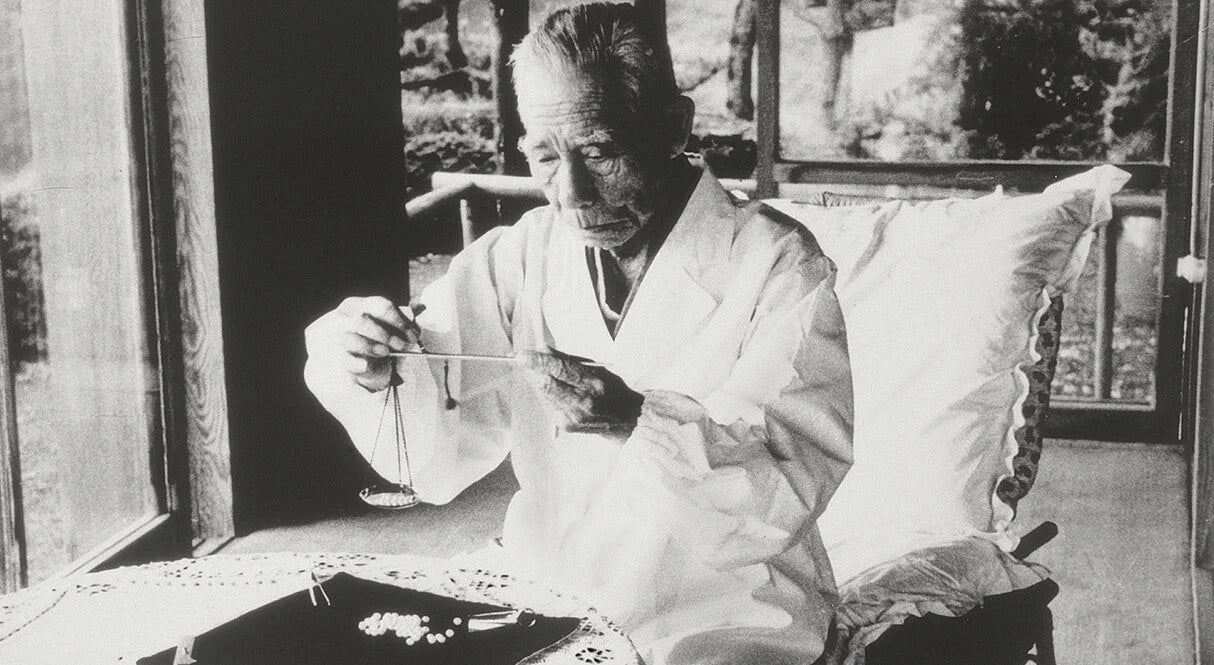
Kokichi Mikimoto in his later years. He was working ‘til his last day on Earth.
In 1916, Mikimoto began mass-producing cultured Akoya pearls and establishing pearl farms across Japan. His pearls became symbols of national innovation. Meanwhile, the global jewelry market — largely unaware of what had happened — was on the brink of a major shift away from natural pearl trade. It just didn’t know it yet.