


If you’ve been looking at pearls, you’ve probably seen labels like “AAA quality,” “AA+,” or “Top grade.” The implication is clear: higher grade, better pearl. The reality is more complicated, because “A–AAA” is a seller-defined label, not a standardized grading system, and it can mean different things depending on who is using it.
Does “AAA” Mean the Same Thing Everywhere?
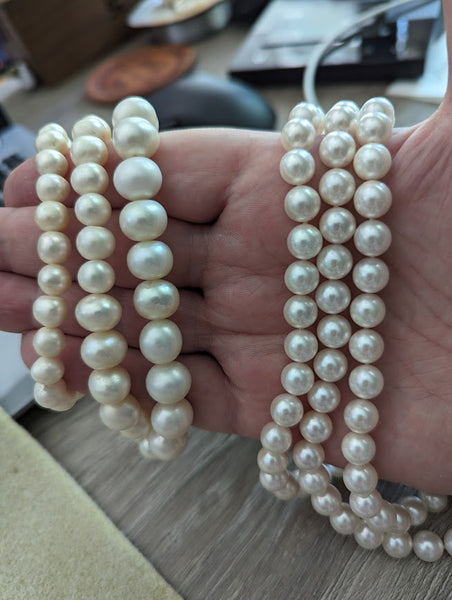
Different sellers use their own grading systems, and what one seller calls “AAA” may not match what another means by it. That’s why two pieces with the same label can look noticeably different — and it’s one of the most common sources of disappointment when buying pearls online.
What Does “A–AAA” Actually Describe?
Usually it’s a shorthand — a way for a seller to summarize luster, surface, shape, and overall appearance into a single label. These are real qualities, but the way they are compressed is not consistent. It depends entirely on who is using the system.
Why Does This Create Confusion?
The label sounds precise, which is exactly the problem. When comparing pearls across different sellers, it quickly loses meaning: on paper, everything may look similar, while in practice the difference can be significant. That gap between expectation and reality is where most frustration comes from.
Not All Grading Systems Are the Same
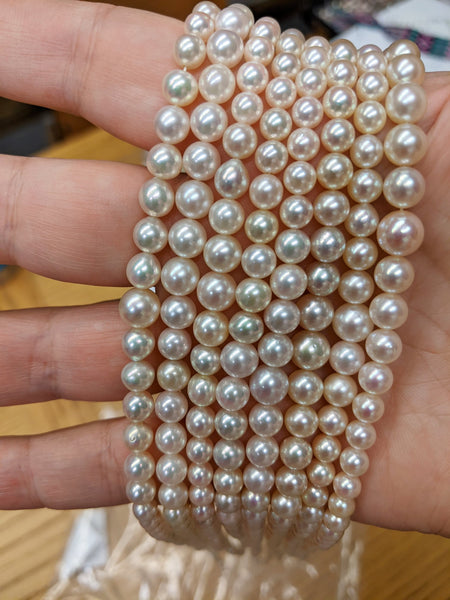
Grading systems exist — but they are not interchangeable. Pearl grading as most people know it originated in Japan with Akoya pearls, and the A–AAA system is familiar but carries no universal definition. There are also region-specific systems: Tahitian pearls from French Polynesia are often described using an A–D scale:
- A: very clean surface, minimal imperfections
- B: slight imperfections
- C: visible imperfections
- D: heavily marked
This system focuses primarily on surface — not the full picture. Two “A” pearls can still look very different depending on luster, color, and depth. Structured systems have real limits.
How Are Pearls Actually Evaluated?
In practice, pearls are evaluated as a combination of factors: luster, surface, shape, color, size, nacre quality, and matching when relevant. These determine how a pearl actually looks. The label is secondary — what matters is what you see. When I evaluate a pearl, I start with what’s in front of me, not with a grade. For a full breakdown of how each factor works and what it means for value, here’s what actually makes one pearl more valuable than another.

How Professional Grading Is Done
In a laboratory setting, pearls are evaluated under controlled conditions against the same factors — luster, surface, nacre, shape, color, size, and matching — and compared to reference examples. The process is closer to: How does this pearl compare to known examples of higher or lower quality? It’s a visual, comparative approach — more precise, and not easily reduced to a retail label.
When Are Grading Terms Useful?
Grading terms can be useful within a single seller’s system — when comparing similar pieces from the same source. Across different sellers, they are unreliable. Grading confusion is also just one of several traps buyers run into. Here are the most common mistakes when buying pearls.
What Matters More Than the Label
Instead of focusing on “AAA,” look at how the pearl actually looks, how clearly it is described, whether treatments are disclosed, and whether the seller explains what you are seeing. That will tell you far more than a label. If you want to understand how these factors affect price: why pearls are priced the way they are.
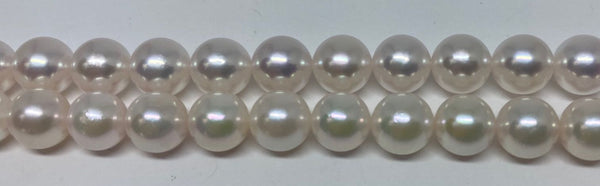
Two Akoya strands, both labeled “AAA” by different sellers — clearly not the same quality.
My perspective: I don’t rely on grading labels — and I don’t use them. They can be useful within a single system, but across the market they create more confusion than clarity.
The Bottom Line
“AAA” is a convenient label, not a universal measure of quality. Once you understand that, it becomes much easier to focus on what actually matters — the pearl itself. If you want to take the next step and choose correctly: how to choose a pearl you won’t regret buying.
If you found this useful, you may also want to read:
→ Pearl Certification: What It Means — and What It Doesn’t
Quick Answers
What does A–AAA mean?
A seller-defined label — not a universal standard.
Is AAA the highest quality?
Not necessarily. It depends on the seller.
Can two AAA pearls look different?
Yes — significantly.
What should I focus on instead?
Luster, surface, shape, color, and overall appearance.